
Tired of weight loss shots that stopped working? A huge new study of over 430,000 patients proves that weight loss surgery helps you drop significantly more weight than GLP-1 drugs—and helps knock out health issues like Type 2 diabetes and high blood pressure for good.
If your weight loss on GLP-1 injections ground to a halt, you didn't do anything wrong.
Every week at Atlanta Bariatrics, we meet patients who started shots with high hopes. At first, the scale moved. But between uncomfortable side effects like persistent nausea, constipation, or acid reflux, and paying upwards of $1,000 to $1,300 out of pocket every month as insurance coverage drops, many people hit a wall. Worst of all, when the shots stop, the hunger and weight usually return.
You haven't run out of options.
A landmark study of 430,000 real-world patients, reported by Today's Dietitian and presented at the American Society for Metabolic and Bariatric Surgery (ASMBS) meeting, settled the debate: while GLP-1s offer a helpful start, surgery consistently delivers bigger, longer-lasting weight loss and far higher rates of disease remission. Leading health institutions, including Mayo Clinic Press, highlight that choosing between medications and surgery comes down to long-term sustainability, durability, and metabolic impact.
What 430,000 Patients Taught Us
Comparing 12-month outcomes across 30 clinical studies shows a clear gap between weekly shots and surgical procedures: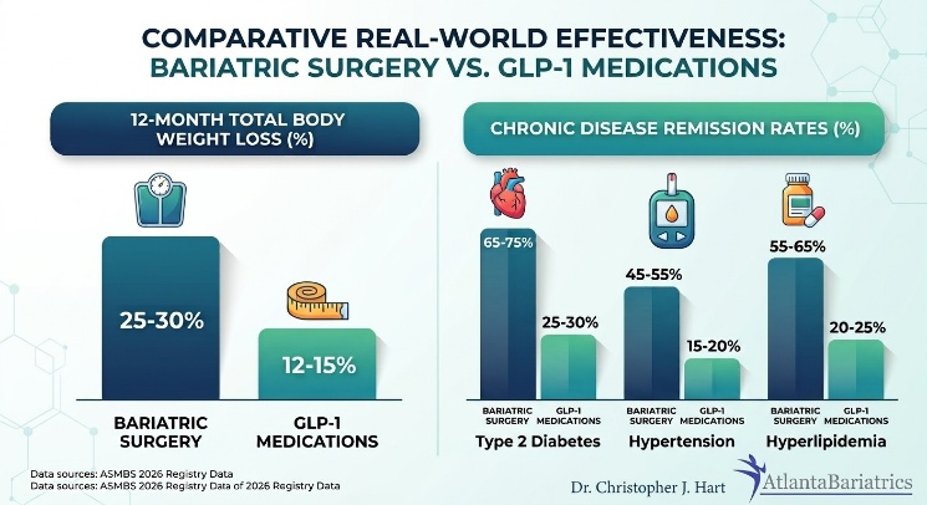
- Total Weight Loss: Bariatric surgery patients achieved over 20% greater weight loss than those on GLP-1 therapy.
- Type 2 Diabetes Remission: Surgery patients achieved a 42% higher remission rate.
- High Cholesterol Remission: Surgery yielded a 20.8% higher remission rate.
- High Blood Pressure Remission: Surgery achieved a 12.8% higher remission rate.
While drug benefits fade once you stop taking injections, procedures like Sleeve Gastrectomy and Roux-en-Y Gastric Bypass provide a permanent metabolic reset by physically restructuring digestive anatomy, reducing hunger hormones like ghrelin, and naturally boosting your body's own satiety signals.
'Did I Waste My Time on Injections First?'
Not at all. Dropping 10, 15, or 20 pounds on a GLP-1 before surgery shrinks the liver and reduces surgical risk, making your procedure even safer.
Think of shots as a helpful starting line. But if you still have 50 to 100+ pounds to lose for your health, surgery is the logical finish line.
Quick Patient FAQ
Can I switch from a GLP-1 to surgery?
Yes. We simply have you temporarily pause your injections a few weeks prior to surgery for safe anesthesia.
Will insurance cover surgery if shots failed me?
Often, yes. Showing that you tried medical weight management without reaching your goals actually strengthens your coverage approval.
Isn't surgery a big step?
Modern laparoscopic and robotic surgery takes about an hour, requires minimal hospital time, and has a safety profile similar to gallbladder removal—without the relentless monthly costs, supply shortages, and GI side effects of lifelong injections.
What does life after surgery look like?
Unlike medications that require weekly injections forever, surgery is a one-time procedure paired with healthy lifestyle habits and targeted daily nutritional supplements to maintain optimal metabolic and vitamin levels long-term.
📣 Fresh Start, Real Facts: Join Our Public Support Group in January 2027
Clear the Confusion: Get Honest Answers Live in January 2027
Forget temporary fixes that fade by February. In January 2027, Atlanta Bariatrics is opening our support groups free to the public!
Join us in-person or virtually as our bariatric surgeons and registered dietitian kick off the new year as guest speakers to answer your questions live. Connect with real patients, cut through the online noise, and get honest answers about breaking through GLP-1 plateaus, post-op nutrition strategies, and long-term success—no judgment, no AI, just facts.
Ready to get real answers? Schedule a consultation with Dr. Christopher J. Hart today, or contact our office to reserve your spot for our free January event!
About the Author
Dr. Christopher J. Hart, MD, FACS, FASMBS, is a board-certified bariatric surgeon, founder of Atlanta Bariatrics, and Chief Resident trained at the Mayo Clinic. With 25+ years of clinical experience, Dr. Hart specializes in robotic sleeve gastrectomy, gastric bypass, and medical-to-surgical weight loss transitions. He serves as Bariatric Medical Director at Emory Johns Creek Hospital and is recognized as an ASMBS Center of Excellence surgeon.
Medical Disclaimer: This content is for informational purposes only and does not constitute medical advice. Always seek the advice of your physician regarding a medical condition.
